
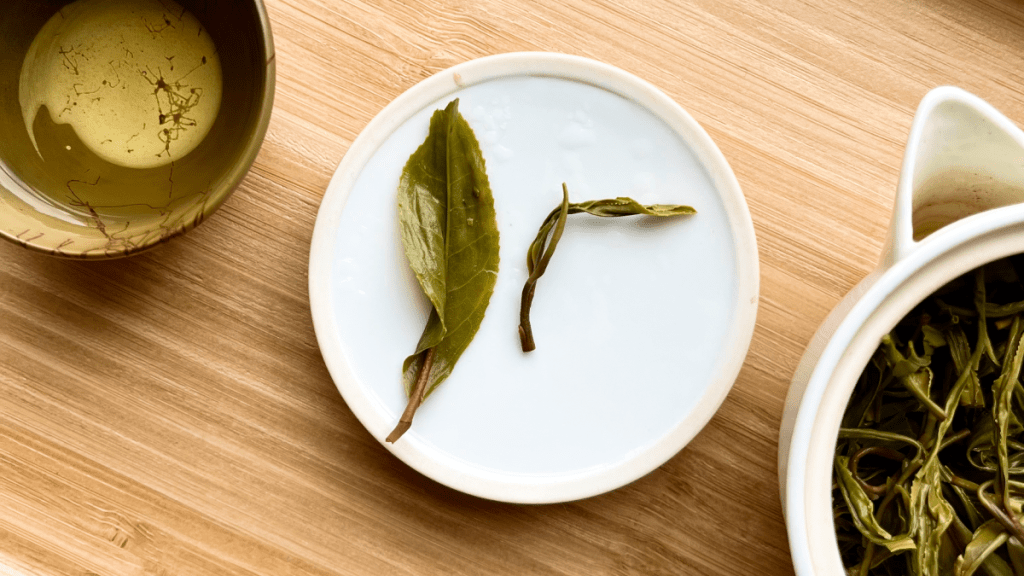
When I was at Obubu last year, I got to handpick and handroll two teas. The first was a wakoucha, and the second I processed as a withered pan-fired green tea. As my first attempts at tea-making, I’m astounded by how well both teas turned out – they’re full of flavour, beautiful leaves still recognisable after my processing.
I’m so thankful to have had these experiences, to have learned from the folks at Obubu and to have been able to use their facilities and harvest from their fields. So today’s blog post is a nostalgic dive into my green tea, covering how I processed the tea, what the final result is like, and some special memories of the day I made it.

Double buds
This is a very special tea to me for a few reasons. Number one, obviously, is that I made it by hand start to finish. As a big tea nerd who’s particularly interested in the processing and methods that go into turning one plant’s leaves into such a wide variety of delicious brews, I don’t think I can put into words how special it was to have this experience, let alone to be able to do it twice. This is actually my second attempt at teamaking – my first was a wakoucha that I’ll write about soon enough. This time, though, I made my tea unsupervised. I didn’t have any experienced farmers or teamakers to guide me or answer my questions. There’s something both scary and freeing about this, when it’s entirely up to you to put theoretical knowledge into practice with total freedom and creative control, and no guard rails whatsoever.
It’s also special to me because of the companionship and support of Sara and Julien, who were also making teas of their own on the same day. We harvested our leaves together, and we did a fair amount of the processing together even though our methods and trajectories diverged quite a bit. But throughout the day, these two friends were there to share in the delights of this experience with me, and all the big emotions that it brought up for all of us – ranging through our own griefs and traumas to our deepest strengths and dreams, and the love we feel for each other.
And lastly, this is a special tea because when we were out in the fields picking the leaves, knowing that this late in autumn we weren’t going to be getting the most flavourful leaves and buds might be rarer, we found quite a lot of plants sending up two buds at once. A mutation? A last bout of growth before winter hibernation? Not sure, but you do occasionally get these double buds growing into a sort of double leaf. And considering that my budding tea company back in the UK is called Leaf & Buds – riffing on the idea that we were two buds sharing loose leaf tea – this phenomenon lodged in my mind as an intensely special thing the fields did just for us that day. We even designed the Leaf & Buds logo to reference this.
I’m not a big believer in fate, but sometimes things just work out that perfectly. Everything happens – not everything happens for a reason – but everything does happen.


Making the tea
I picked the leaves for this tea by hand in the Okumidori section of the Monzen tea field at Obubu. Previous-intern-turned-kickstarter-manager Sara and I headed out in the van, and we were joined by fellow-intern-and-bicycle-fiend Julien, who cycled up the mountain to meet us in the fields. We were picking for a few hours, enjoying the absolutely glorious weather and truly luxuriating in this once-in-a-lifetime experience.
By this point, we’d all spent a fair bit of time out in the fields, but there was something special about the vibe on this day. Maybe it was not being on a work schedule, or knowing that the end of my time in Wazuka was rapidly approaching – it was easier than ever, on this day, to be truly there with all my senses, to see hear smell taste feel it all. Delicate soft buds, the raven cawing, little bugs, spiders, the dry heat of the dirt on the track, humid hot shade between the sunlit tea rows cut with fresh breeze moving in a rustle through the leaves. I remember talking about some really deep life-affirming things with Sara and Julien while we plucked our leaves, and feeling seen, trusted, and loved in ways I’ve not often experienced.
When we returned to Obubu, I left my leaves to wither, unsure what I wanted to do with my tea and deciding to trust in the vibe of the day so far. Considering that my wakoucha’s withering process took a long time because of the warmth and humidity in the air, I figured that even if I wanted to make a green tea, a little bit of withering wouldn’t take it too far.
A few hours later, I came back to check on the tea, and decided I did want to pan fire it after all. This is something I’d thought about doing with my wakoucha, but hadn’t done, and as Sara and Julien were setting up the wok to fire some of Julien’s batch, I figured I’d tag along. This is the art of tea making!


My only goal for this batch of tea was to attempt hand-rolling the leaves into the classic sencha needle shape. Of course I’d already gone rogue by letting the leaves wither for a bit, and then pan firing them instead of steaming meant I was going to be making a withered kamairicha. But even if it was a bit unusual, these decisions didn’t preclude some hand-rolling!
The thing about hand-rolling, though, is that you need to keep the leaves at a warm temperature so they stay pliable and fresh. But heat will evaporate moisture out of them, not to mention rolling squeezing it out too, and drier leaves are more breakable. Usually this is done on a hoiro, a washi paper lined table heated from beneath to around 80 C. Obubu does have one of these, which is used at hand-rolling events, but seeing as I was doing this project on a weekend on the side, and hadn’t thought to plan ahead, I didn’t know how to control the temperature.
I figured I’d best leave it alone, and got a bit creative about my methodology instead. I wanted to keep my leaves warm but not hot, and top them off with heat throughout the hand-rolling process. So rather than pan-firing the leaves once, and then rolling them, I went back and forth between the two. At first, I fired the leaves for 5-10 minutes in the wok, followed by around 15 minutes of hand-rolling them in a bamboo tray. After two rounds of this, my leaves were losing a lot of moisture, and I shortened the pan-firing time to just about a minute – just enough time to get the leaves warmed up again, followed by another 15 minutes of hand-rolling.
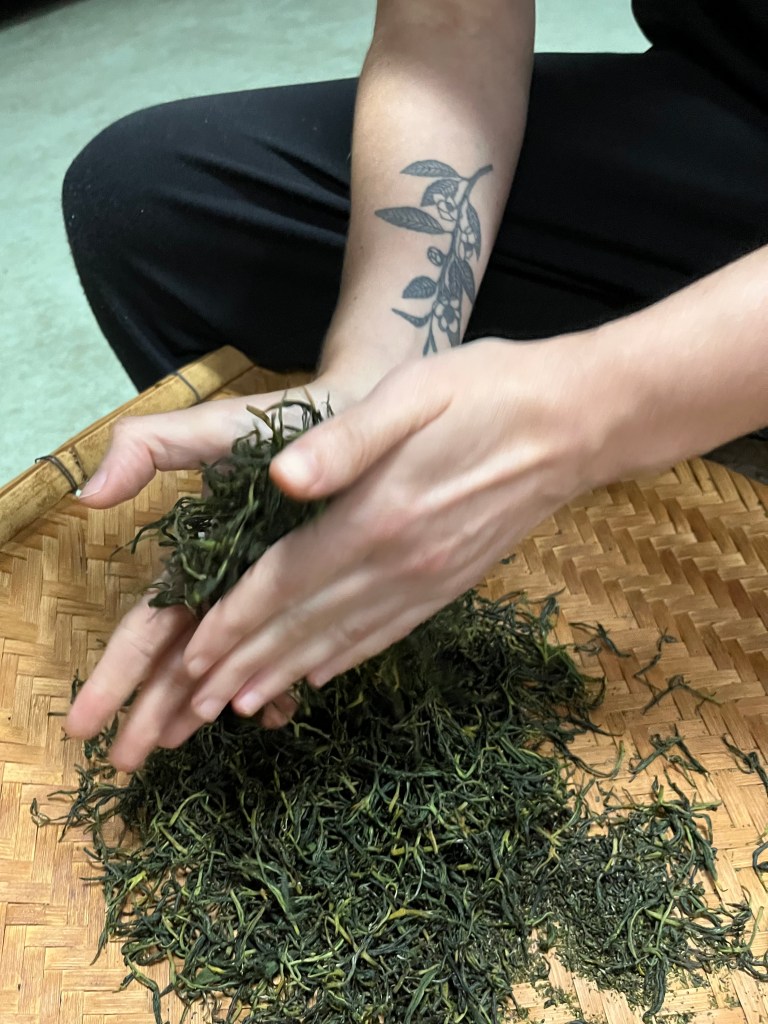


Miwako-san had showed us how to do the needle rolling by hand during our wakoucha making days, and we’d also learned from Akky-san and Hiro-san at the hand-rolling event a few weeks before, so I had some idea what I was doing. Obviously though, hand-rolling is not a skill you pick up after seeing it done once or twice, especially when you’re really just playing around on a weekend with no expert to guide you. And Wazuka has Experts with a capital E – Kenta-san of Hosoi Nouen, winner of 2023’s National Japanese Tea Hand-Rolling Competition, regularly works with Obubu hosting hand-rolling experiences and classes. The week after I made this tea, I got to see him at work briefly during the Japanese Tea Master Course. This was an incredible experience and one of the many things that made me wish I had more time there – the smoothness and coordination of his motions, the ease with which he scooped leaves and kneaded them, the wealth of his experience and knowledge.
As my leaves started losing moisture and becoming more fragile, I was finding more and more reasonably needle-like shapes. I started to wonder how I’d know when I was finished, but also I was aware that really I had no idea what I was doing, so it would be no use overthinking this. I figured I’d quit while I was ahead, rather than risk breaking any of the nice needles that I had managed to roll. By this point, the symbolism of the day was starting to get to me, and I decided to finish my pan-firing / rolling process with its ninth iteration. As a synaesthete, numbers have a lot of colour, texture, and personality for me, and ironically given the weather that day, 9 is the least sunny of my numbers, but it is fittingly the one that feels most like a friend.

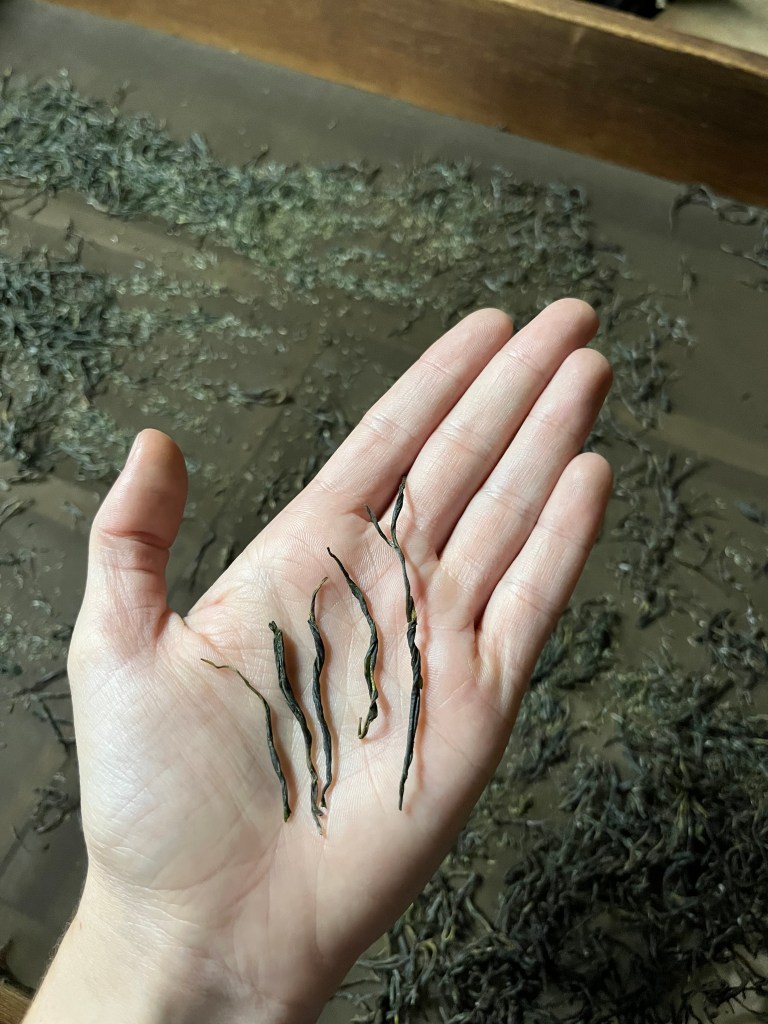
This process took about two and a half hours total, at which point I needed some food, so I left the tea to rest for another half hour while I had dinner. Returning to the tea, it was definitely too dry to continue any sort of processing without risking breaking my little needles, so I decided to wrap up the process in the dryer. My tea only needed about 20 minutes in the dryer in the end, starting at 70 C, going up to 90 C for a few minutes, and ending back at 70 C.
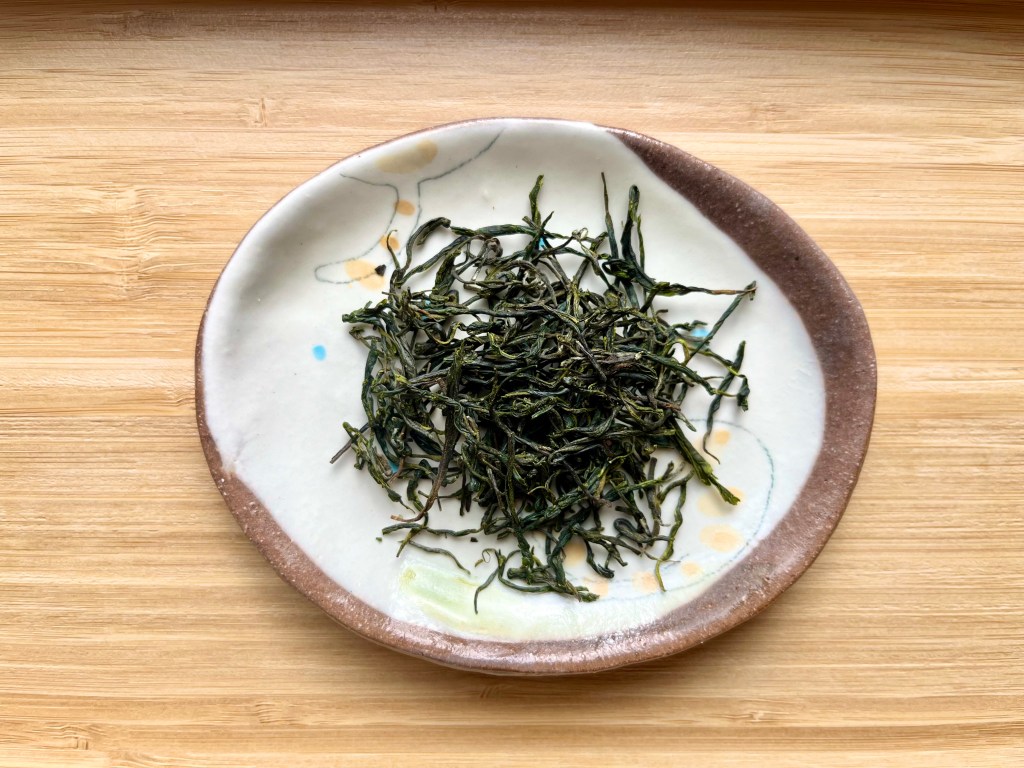
The resulting tea smelled warm and toasty, and my greens had gone slightly darker forest green from their previous light neon. I ended up with only 71 grams of tea.
Processing tl;dr
- 10.30: Harvesting Okumidori at the Monzen tea field, picking double buds where possible, otherwise a bud and two leaves
- 13.00: Withering outside under a cloudy, humid, warm sky
- 16.30: Pan-firing to stop oxidation, then rolling and pan-firing quickly in alternation to keep the leaves warm as I rolled them
- 19.00: Resting the leaves
- 19.30: Drying the leaves
Extra buds
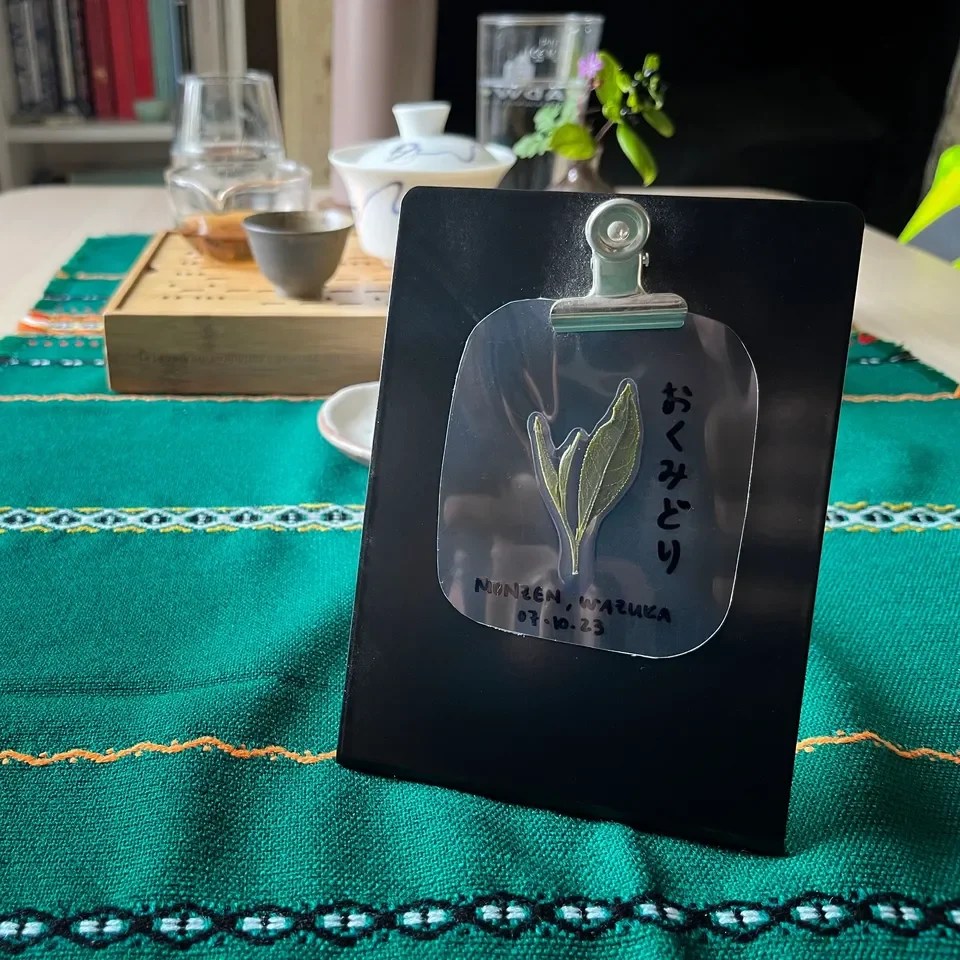
I kept back a few of the most perfect double buds to play with separately. One of my senpai interns, Juliette, had done a beautiful thing where she laminated a few tea leaves to preserve as gifts. I thought I’d take a leaf out of her book, as it were, and tried the same.
I steamed these few leaves on the stove to maintain their bright green colour, and then arranged them on a cotton sheet which I pressed in a stack of books for the following week. After this I laminated the leaves, cut them out into small square-ish shapes, and labeled them with the details of their picking – date, location, cultivar. They ended up as beautiful mementos of one of my favourite days in Japan, and I keep one on my tea shelves now next to my Japanese teaware. The rest have made their way to friends’ and loved ones’ homes, with one of course going to Kartini, my Leaf & Buds co-founder.
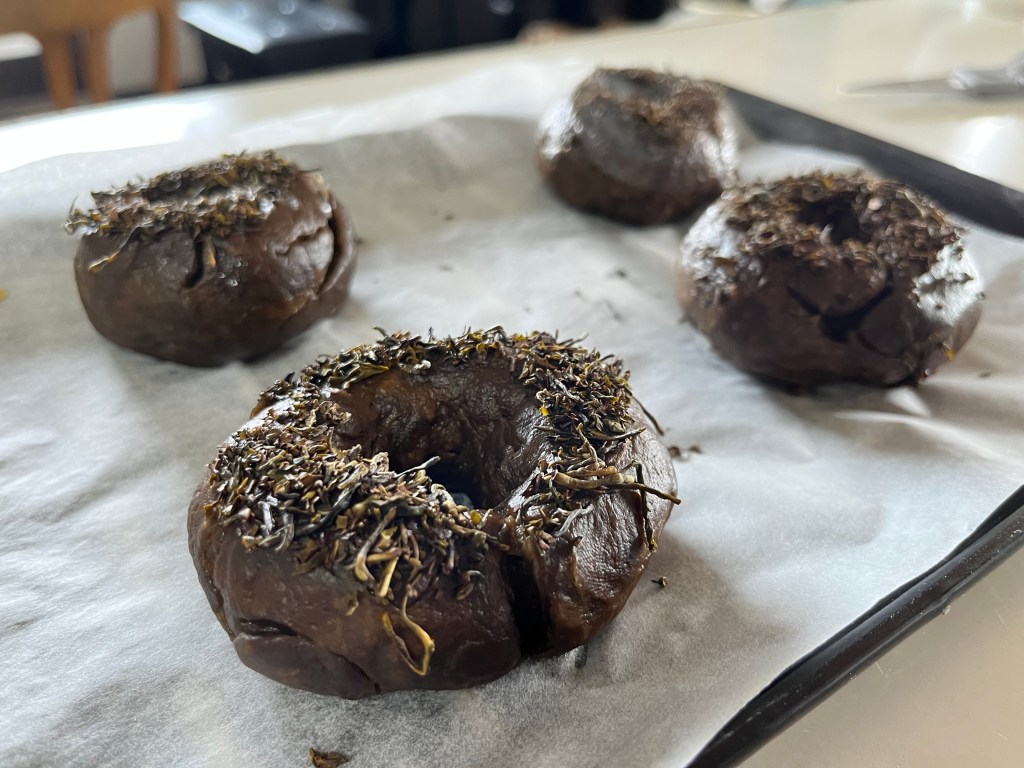
An unexpected side effect of rolling in my bamboo tray was that all the smaller particles that did break off of my leaves as I rolled them were conveniently collected in one place, and I found a creative use for these, too. On the same weekend I made this tea, I was also experimenting with making black tea bagels using Obubu’s wakoucha cooking powder. I roasted the broken bits of my green tea into a sort of hojicha, and topped the bagels with this material for a bit of crispiness and extra flavour – it was a hit with everyone. Look out for that recipe coming to the blog soon too! Just need to get some reasonable photos of the bagels-in-progress.

Tasting notes
Because I made very little of this tea, and gave quite a bit of that away, I’ve only tasted it a few times. These tasting notes are gathered from those few sessions, as well as from input from my family who I brewed it for over Christmas.
On the dry leaf aroma, I get cabbage, grilled courgette, salt water, burnt pastry crust, and roast broccoli. When the leaf is wet, the aroma moves towards a seaside vegetable garden after a spring rain. On the aroma also is the sense-memory of sitting on the wooden bench in the sencha factory at Obubu, rolling these leaves in a bamboo tray, tossing them in the wok, their aromas rising, coating my hands for hours afterward and my memory for ever.


The liquor is a thick, opaque green, with the leaf opening into a full dark green with glorious neon highlighter greens streaked throughout. There are also some hints of darker, more oxidised mahogany stems here and there, showing that I didn’t do a perfect kill-green job and some of the thicker material did continue to oxidise a tiny bit.
With the first infusion around a minute and a half at 65 C, the liquor has a heavy, thick, velvety texture, coating the mouth. The flavour is courgette through and through, leaving a silky mouthfeel too. It’s very sweet, with some astringency coming in at the end to temper it. Mild and not overpowering, but very balanced.

A second infusion, hotter and shorter, moves the flavour away from the courgette flesh towards courgette skin, and other dark leafy greens. This brew starts off less opaque but retaining the thickness, with the opacity returning as the liquor sits.
It’s like a meal, but not in the way steamed greens are soup-like – this is more spinach-filled puff pastries, roast courgette and broccoli, steamed kale. An intensely green veg-filled feast.
A cold-brew with the leftover leaf gives a very light, refreshing, floral dew brew returning to the courgette skin flavours. A perfect afternoon pick-me-up.
Some musings on the whole experience
One of my tea teachers once said, really off-hand in passing, “Be in service to the vibe.” I don’t remember where or why or what was going on, but it stuck in my brain, and every now and then it swims to the forefront of my consciousness as the only true and indisputable fact of the universe.
Making this tea felt like that – I didn’t try to control everything, I didn’t try to make something perfect or impose my limited knowledge and experience on something vastly bigger and more complicated than myself, I just felt the vibe that day, and followed it.
At the end of the day, that’s what tea is about, for me. Approaching something new, no matter how familiar, with an open, peaceful, curious mind and heart and body, and being open to the vibe. I’m not a spiritual person, and my brain is sometimes a bit too spicey to process abstract things like this, but somehow this is the thing that works for me. Find the vibe. Be in service to it.
I have just a few grams of this tea left now, maybe one or two sessions. Not sure when I’ll drink it, if it’ll be a special occasion, maybe marking the day I cross paths with my Obubu mates again, or if I’ll just be struck with the vibe on a random day. Either way, I’m looking forward to it. And to the day I get to play with woks and bamboo trays and soft fragrant leaves again.

 Tea with Maren
Leave a comment