

Hello friends! It’s been a busy crazy week, and I finally have some exciting tea-making stories to share.
The thing I was most excited to learn more about when I came to Obubu was tea processing, and unfortunately the timing of my stay here has fallen a bit awkwardly between summer and autumn harvests, so my first month and a half here have been quite light on the tea processing side. But on Friday I finally had my first full harvesting/processing day, and it was everything I wanted and more.
I wrote about Aoi Mori a few weeks ago – it’s the field managed entirely by Obubu interns and staff, rather than our lead tea farmer/tea wizard Akky-san. It’s a somewhat more experimental field, where we can try new or unusual things – including ‘autumn shincha’. Shincha literally means ‘new tea’, and the term usually refers to the tea made from the first spring harvest. But of course tea plants do continue sending up new shoots throughout the summer, and we’ve been seeing lots of shiny new buds on recent weeding trips to Aoi Mori. The flavour profile of these will be a bit different from the earlier spring flushes, and the rest of the leaf material on the tea bushes is older and coarser this time of year, so autumn harvests aren’t often used to make sencha, they usually become bancha or houjicha. But the Obubu staff decided to give us the full sencha experience, so taking ‘shincha’ literally, we spent Friday making tea with new autumn shoots.
This week we were also joined by the incoming intern cohort, and harvest day was their first full workday at Obubu. So eight of us interns were experiencing our first ever harvest under the guidance of Hiro-san, Kayo-san, Miwako-san, and Jean, our brilliant staff and assistant managers. We had three harvest machines to use, each operated by a team of three with floating helpers to move full bags of tea, get fresh bags, and clear the to-be-harvested tea of any errant weeds.
Tea fields in Japan are generally cultivated and maintained in well-ordered lines, and bushes are trimmed regularly to maintain their curved shape. This makes it easy when it comes to harvest time – the harvesting machine is operated by two people, one on either end of the bush, and the machine covers half the curve of the bush at a time. The team of two proceeds down the row, with the machine’s blades cutting the tea at the level it’s held above the bush, with air blowing the leaves back into the bag attached to the end of the machine. A third person follows behind supporting the bag.
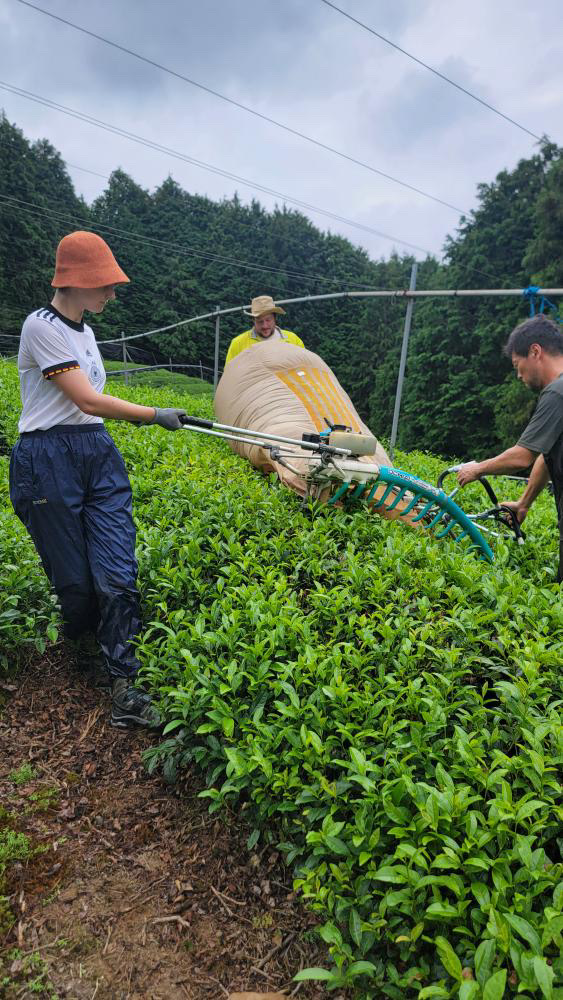
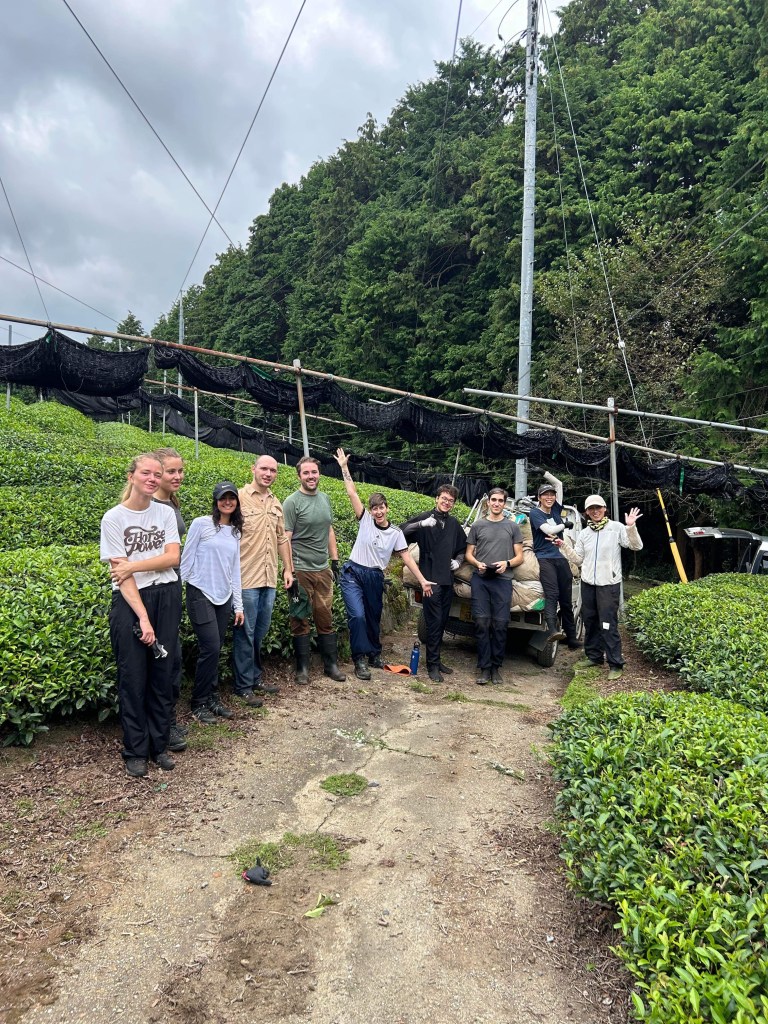
Having so many people around meant that everyone could rotate around the different roles and experience all aspects of harvest – from actually harvesting to running around with full bags of tea to fleeing wasps.
Because we were cutting at an even level, we were getting different leaf material depending on how the tea had grown. We aimed for the usual bud and two leaves, but with some taller shoots we got more material, and sometimes a sneaky weed made its way in the bags too. This meant that once we got back to the factory with all our harvested leaf, we needed to do a bit of a sort as the fresh leaf was going into the steamer.
The tea processing was led by Kayo-san, one of Obubu’s staff members who usually manages the Obubu tea club and domestic orders, and has a hand in pretty much everything else. She’s incredibly knowledgeable and delightful to work with, always taking the time to show how she knew the tea was ready for its next stage of processing, and trusting us to execute on our tasks while she was elsewhere in the factory.
Maybe I’ll do a video tour of the sencha factory at some point, but the broad strokes of sencha processing are as follows:
- Freshly harvested tea leaves are steamed to stop them from oxidising
- They are rolled, pressed, and twisted with increasing pressure to squeeze out the excess moisture and break down cell walls to release flavour
- They are shaped into the classic sencha needle shape and dried
This process can be done entirely by hand, and that’s a whole other experience I want to have at some point, but usually it’s done in a factory with various machinery. We got back from Aoi Mori around 13.30, and started steaming immediately. The machines can only take so much leaf at once, so we were processing long into the evening. As in the field, we followed Kayo-san’s lead, learning various machines and supporting where needed. The rolling machines needed constant attention to adjust pressure and timing, and Kayo-san continually showed us how to test the leaf for moisture content through smell, temperature, and texture.

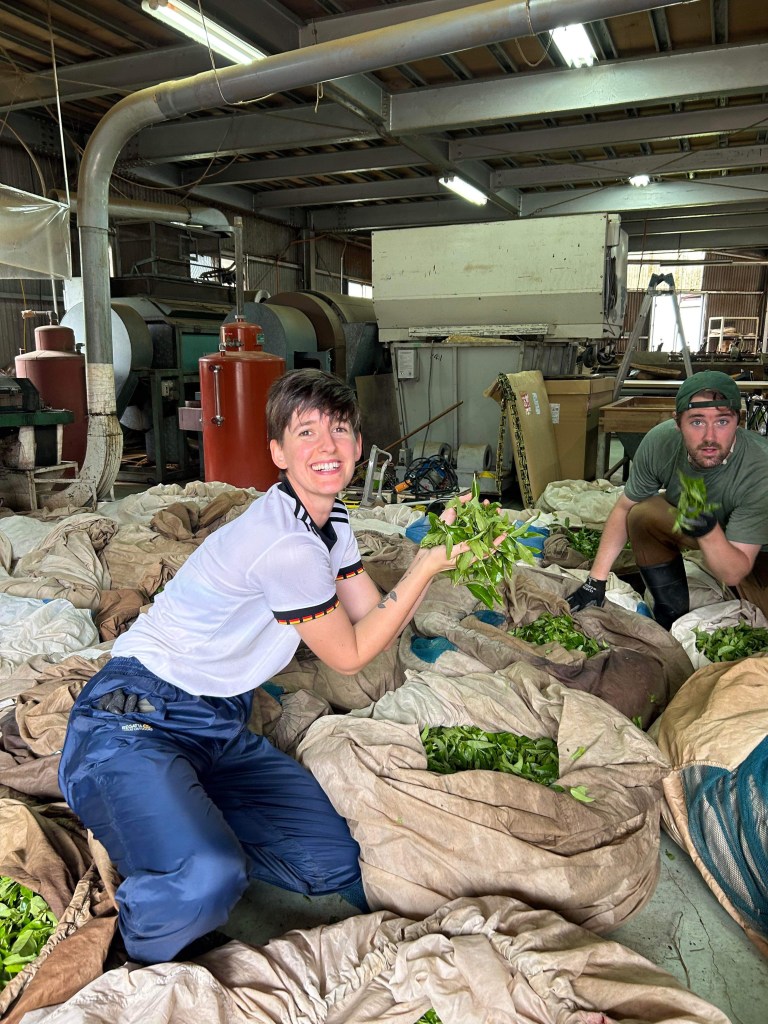
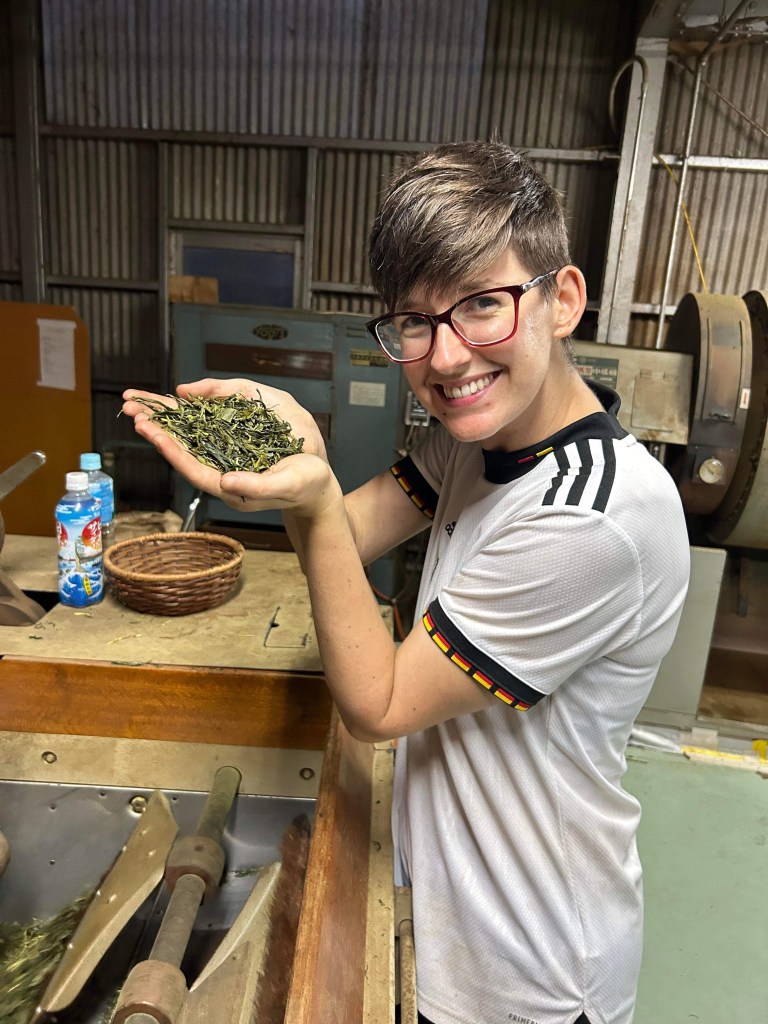
My favourite parts of the day were the quiet(er) moments just watching the leaf tumble, smelling the hot tea air coming out of each machine, and touching (and snacking on) the leaves as they proceeded around the room. Feeling, smelling, and tasting this transformation into tea for the first time is one of the greatest experiences I’ve ever had. You can learn a lot in books and online, but there’s nothing like doing it yourself, and being surrounded by folks who know this process intimately and who are excited to answer all my tiny huge questions.
In the evening we even got a taste of our harvested and processed tea – the freshest tea I have ever had. A very pale green opaque brew, light and grassy with a distinctively avocado-y note. I wish I’d gotten a picture, but I was too busy soaking up the moment to remember to document it, and there will be chances soon enough to drink more of our tea, take photos, write tasting notes, all that.
It’s strangely difficult writing about an experience like this, that I’ve read about and watched videos of and learnt so much theory about, especially when it’s wrapped up in a lot of emotion and excitement and dream-fulfilment. I need a bit of processing after all the tea processing! Things here are very busy and full-on all the time, and I don’t usually have a camera available to document things, so I have far fewer photos/videos than I’d maybe like.
But the bonus of that is I’m really focused on things as they happen – I feel here, all the time, in a way that I struggle with usually. That immediacy and presence has been so helpful for my mental health, but maybe less helpful for sharing deep insightful reflections with my legions of devoted fans… or loved ones back home who’d like occasional reminders that I’ve not fallen into a teapot and not come back out 🙃
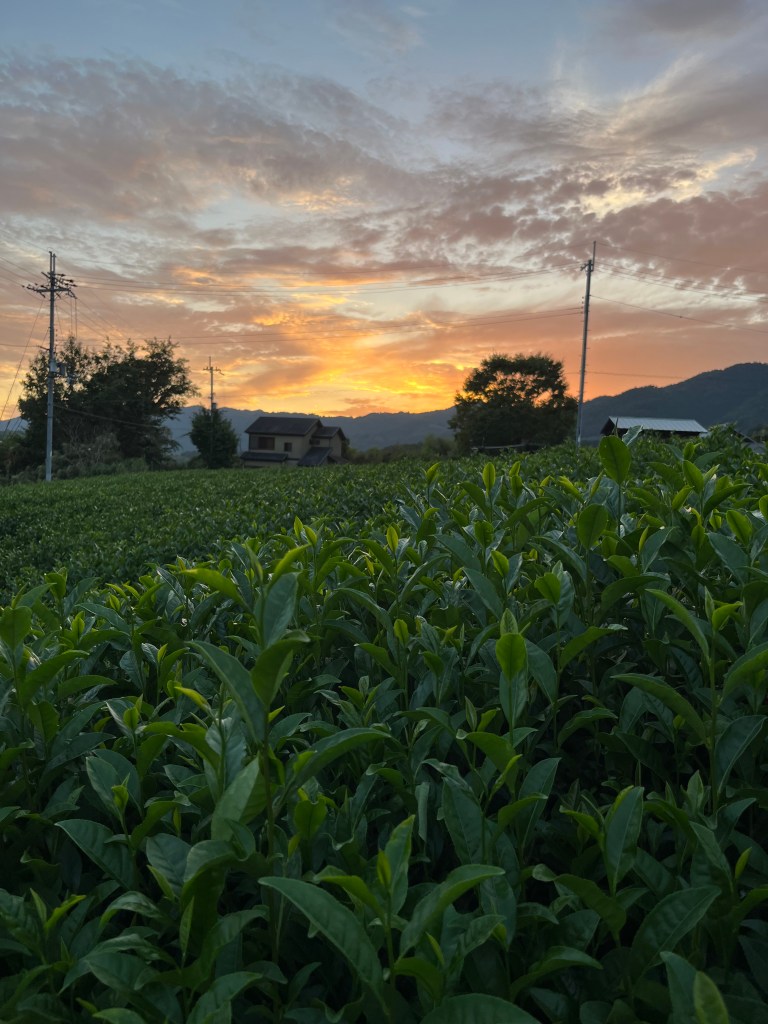
Meanwhile Wazuka continues to provide spectacular sunsets every evening, and with cooler weather coming in now it’s much more reasonable to be out working all day.


With new interns settling in, I’ll be having more time to work on my various Obubu projects – social media stuff, untangling some website worms, sociolinguistics on tea terms. I’m looking forward to passing on some of the things I’ve learned in my time so far with this new group. We had a very enjoyable welcome party for them earlier in the week – I think by now I’ve perfected the carrot cupcakes with genmaicha icing, so I will share the recipe soon!
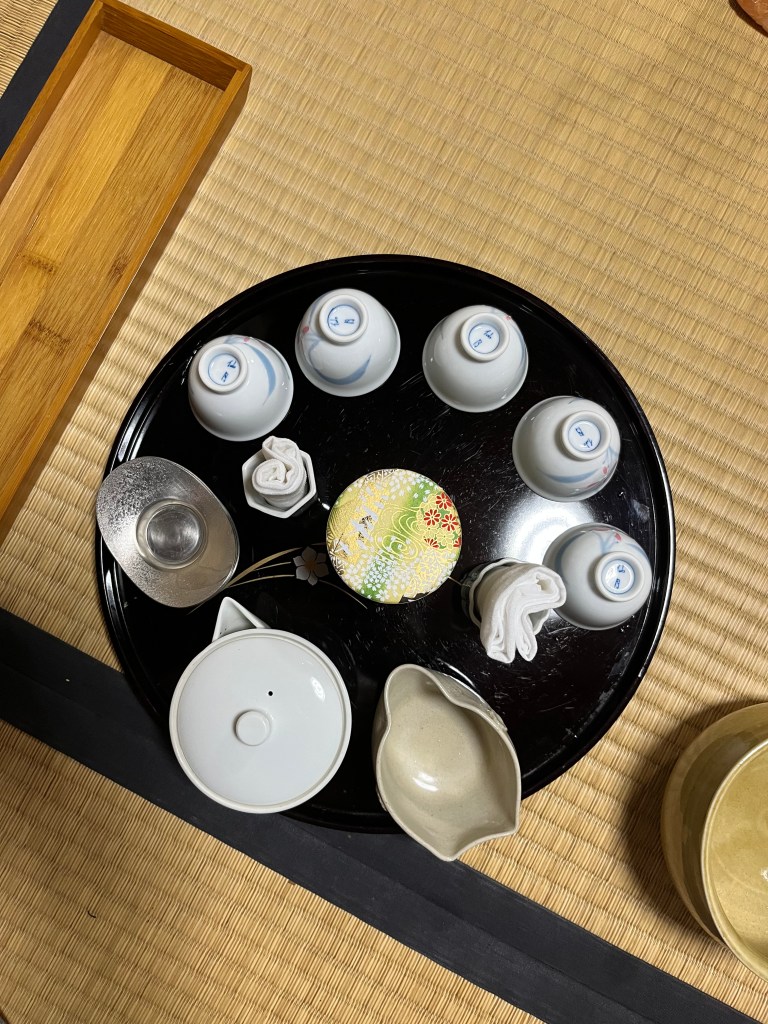
I’ve also been sharing out some puers and other fermented teas with the other Obubu folks, and hosted some really enjoyable tastings this weekend. Good practise for Leaf & Buds! Sencha-dō classes are going really well also – this is where together with other interns I’m learning the ceremonial preparation of sencha with a local teacher. There’s something incredibly satisfying about all the small, precise movements and changes of hand that take place in the ceremony, and I’m continually delighted by the new variety of sweets we get to try every week. I’m pretty sure I’ll acquire the enough teaware to practise this back home for anyone who wants to experience it as well! I have quite a few more weeks of practise to go after all.

 Tea with Maren
Leave a comment