
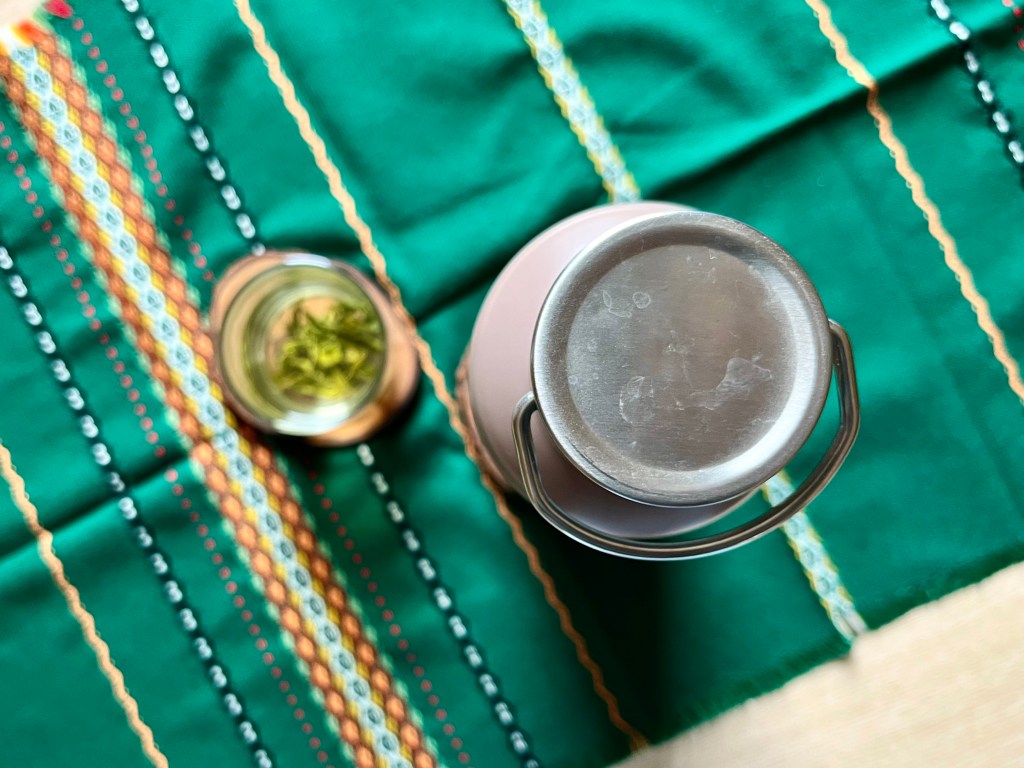
Today we’re talking about (or around) that very classy tea accessory you didn’t know you didn’t need – the gooseneck variable temperature kettle.
There are tons of good guides on variable temperature kettles out there – from Mei Leaf, Nannuoshan, etc. But do you really need one? Aesthetes, weigh in with your opinions on what looks best on the tea table. But I’m a rogue when it comes to measuring things, so here’s my approach to getting my water temperature how I like it without a variable temperature kettle.
The method
There’s really only one thing you need to know about water temperature, and it’s this:
Hot water will lose about 10 C / 18 F of heat for every transfer from one vessel to another cold vessel.
So tldr for the rest of this post: it’s all about transferring the water from your freshly boiled kettle to get it down to whatever temperature you want.
Of course, there are other methods too – you can look at bubble size and shape in a boiling kettle to determine its temperature (you need to be able to watch your water boil for this – ie. glass kettle or stovetop), you can mix boiling water and room temperature water in different proportions, you can stop the kettle before it boils all the way, etc. But I go with this transfer method because I find it really straightforward and intuitive, and you only need tools you can find in pretty much any kitchen, even hotel room kitchenettes.
The tools
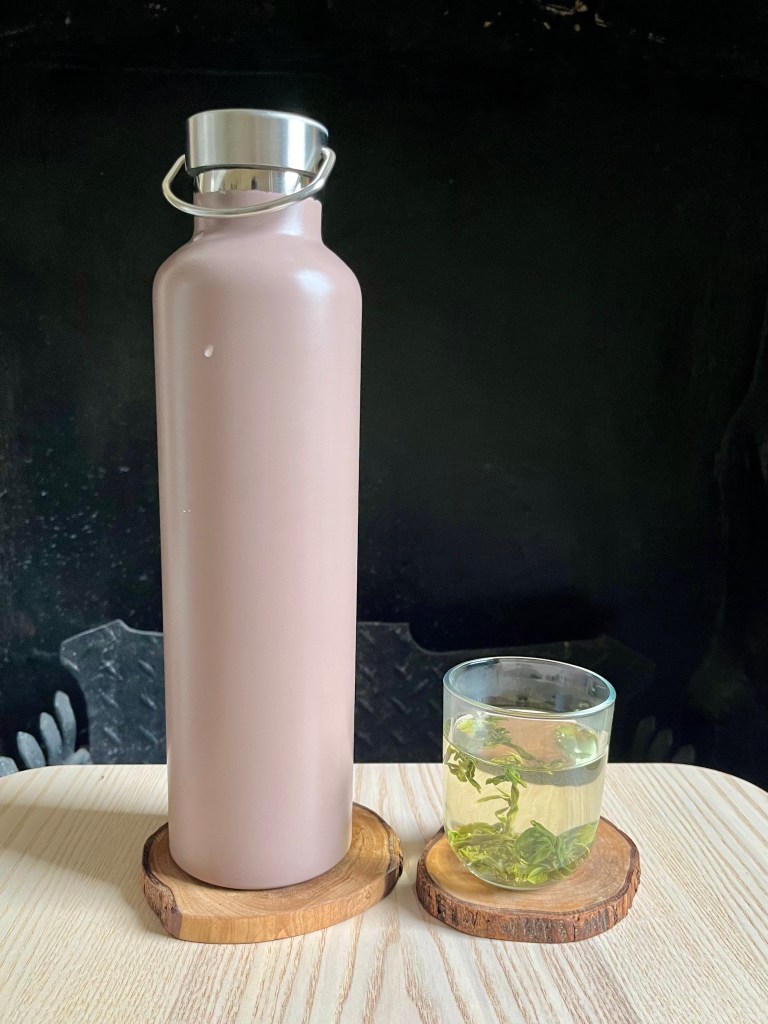
I brew from a thermos – I prepare my water ahead of time, and then when I sit down for a tea session I’ll just be topping up from the thermos rather than from the kettle. That means I don’t need a lot in the way of equipment:
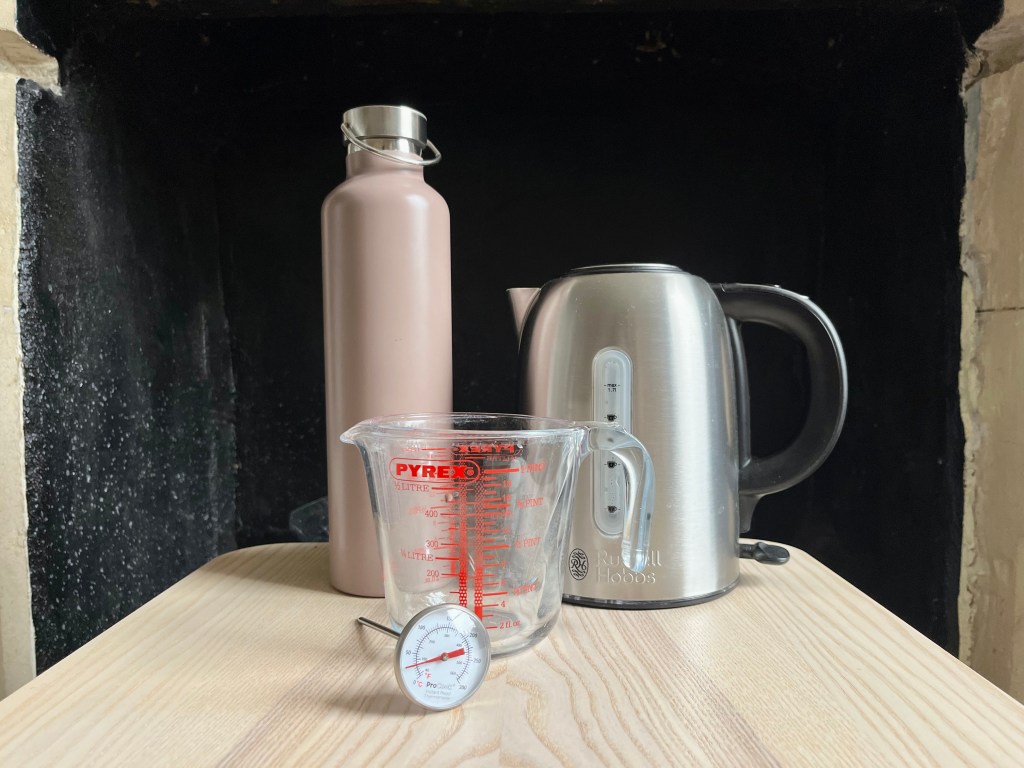
Essential:
- kettle
- jug (I use a glass pyrex jug, and sometimes a plastic one, but a spare mug will do in a pinch)
- thermos
Optional:
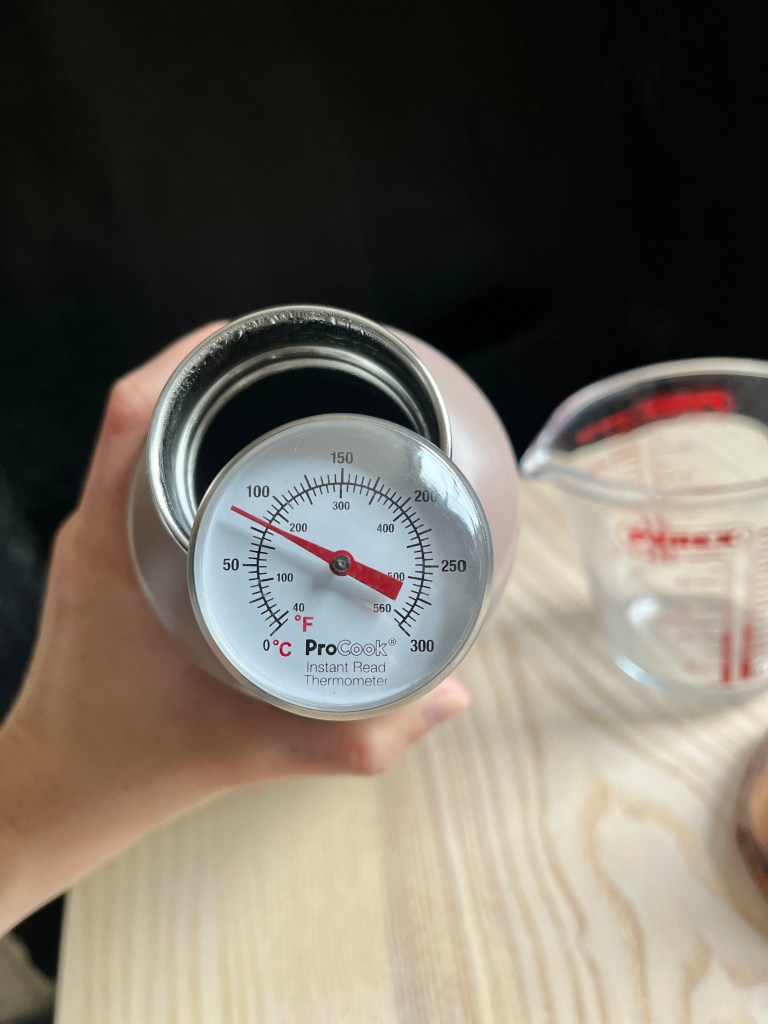
- thermometer (if you want to double check your water temperature)
The temperatures
| Temperature | How to get there |
|---|---|
| 95 C / 203 F and up | If you’re brewing from a thermos, and not directly from the kettle, you’re not going to have boiling water except on the very first infusion because water always loses heat in the transfer to the thermos. So to get the water in the thermos as hot as possible, preheat your thermos – pour boiling water in, swirl it around and dump. Then fill the thermos with boiling water. This usually gets me around 95 C / 203 F in the thermos. Part of the point of preheating teaware is to prevent shocking it with hot water – so even if I’m wanting to brew with boiling (or as close to boiling) as possible, say for a shou puer with some storage on it, I’ll usually heat my teaware with something just less than boiling. Preheating the thermos is perfect for this – boil the kettle, pour some boiling water in the thermos, give it a swirl, and use that water (which will be around 90 C / 194 F) to heat your teaware. Then use water from the freshly boiled kettle for the rinse and first infusion. At that point, get the rest of the kettle transferred into the preheated thermos. This way I’ve found I’m usually using somewhere between 95-98 C / 203-208 F the entire time. With hotter temperatures in a thermos, though, you sometimes get a bit of a dip in temperature as the water level in the thermos drops – cold air coming in every time you open, more evaporation inside, cooling itself faster, etc. Don’t worry, you can always top up with more freshly boiled water to bring up the temperature, and a little inadvertent dip brewing never hurt anyone. |
| 90 C / 194 F | This is the easiest one – it’s a very straightforward application of the principle we started with. Just boil the kettle and pour it in your thermos. It’ll drop by about 10 C / 18 F, giving you 90 C / 194 F water. |
| 80-85 C / 176-185 F | Boil the kettle, pour it in your jug, and then pour that into your thermos. Two transfers will take about 20 C / 36 F off the water. If I’m going for 85 C / 185 F, I’ll usually fill 3/4 of the water into the jug, then from there into the thermos, and top the remaining 1/4 of the water straight from kettle to thermos. |
| 70 C / 158 F | For 70 C / 158 F and lower, I usually use two jugs. Boil the kettle, pour the boiled water into one jug, then into the second, then into the thermos. The three transfers will have taken off about 30 C / 54 F. When I don’t have two jugs available, I’ll usually just top off the water in the thermos with about 150 ml of room temperature water – this usually gets me in the 70 C / 158 F ballpark for my 1 l thermos. |
| 60 C / 140 F | This one’s also a double transfer – boil the kettle, pour off into one jug, then into the next, then into the thermos. At this point I’ll usually add another 150 ml of room temperature water. With just one jug available, I’ll just do one transfer and then top off about 300 ml room temperature water instead. |
You can see that I play kind of fast and loose with my water temperature. So if I’m going for somewhere between these levels, I’ll usually do it by adding 100 ml or so of room temperature water to my thermos to bring it down a few degrees. Of course room temperature is different at different times of year (especially in our wildly drafty kitchen), so it’s really more of an estimation always, but it’ll get you in the ballpark.
The moral of the story
I think there’s a fear that lots of folks have around delving into tea and all the kit you seem to need to do it ‘right’, and variable temperature kettles tend to fall into that. But there is no ‘right’ – I’ve been deep into tea for over ten years now, and only had a variable temperature kettle for a bit of that time. It was a cheaper brand and the base melted after about a year and a half – RIP kettle and my lungs for all the plastic fumes inhaled that day.
But to be honest, I’ve had a lot of fun brewing without. I don’t even usually measure my water with the thermometer. But in putting together this post, I realised that I have a damn good sense for water temperature even without tools to adjust by single degrees, and that’s all down to years’ worth of experimentation and practice.
The instant read thermometer I have cost about £5 – that’s a lot cheaper than even the cheapest variable temperature kettles. Even if you don’t want to splurge on that, this guide should be a good starting point for anyone wanting to develop their own sense for water temperature. Of course, all of this is pretty precisely calibrated to my own kettle, thermos, and jugs, and I live pretty close to sea level so this may be entirely different for folks at higher elevations. But the concepts should be pretty transferable.
And at the end of the day, what matters a lot more than the exact temperature of your water is how you like the tea you’re brewing with it. People can tell you all they want that a particular tea is meant to be brewed at exactly 85 C / 185 F, but if you like it kettle-boiled-then-transfered-to-a-jug-then-mixed-with-a-dash-of-room-temperature-water, then that’s the ‘right’ temperature too, and I’d love to try it next time I’m visiting.
 Tea with Maren
Leave a comment